
Before I became a full-time recluse and transplant advocate, I used to be an analyst in a corporate job, crunching numbers and creating charts and graphs in my bland gray cubicle. The powerful urge to dig through data and statistics remains with me, and I have been digging deep into online data on the history of transplants, particularly heart transplants, as well as the accompanying pharmacology.
The kidney was the first human organ to be transplanted in 1954. Thirteen years later, Dr. Christiaan Barnard performed the first human heart transplant surgery on December 3, 1967. The transplant recipient was Lewis Washkansky, aged fifty-three years, and he died within a short period of time due to rejection. It wasn’t until 1983 that cyclosporin, the first immunosuppressant drug developed to prevent organ rejection, was introduced.
Early transplants had only corticosteroids and, later, Azathioprine to prevent rejection. Since the introduction of cyclosporin in 1983, multiple immunosuppressant drugs have been introduced to prevent rejection of solid organ transplants. From 1983 to 1999, seven drugs were approved for use, but only one drug between 1999 and 2019 was approved. Below is a timeline of the appearance of those drugs.
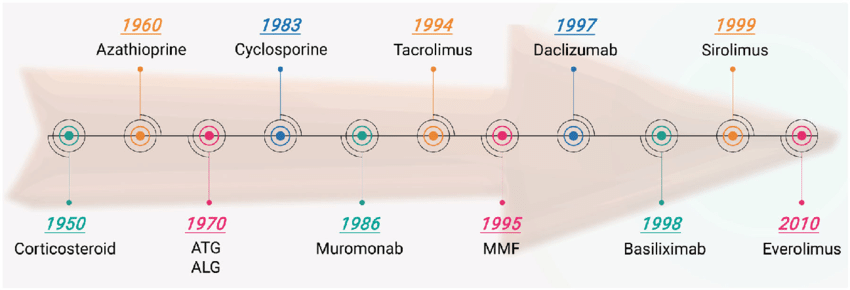
(Table from Hakan Parlakpinar & Mehmet Gunata (2021): Transplantation and immunosuppression: a review of novel transplant-related immunosuppressant drugs, Immunopharmacology and Immunotoxicology.)
The most recent novel drug to be developed for preventing rejection of a transplanted organ is Belatacept, which recently completed Stage 4 clinical trials for kidney transplant recipients. This drug is administered via IV once a month, eliminating the need for daily pills.
The same research paper that provided the timeline above also has a list of fifteen separate immunosuppressive agents that are currently undergoing clinical trials. Most of the drugs on that list have been developed for the purpose of treating conditions other than organ transplant, such as rheumatoid arthritis, lupus, ulcerative colitis, plaque psoriasis, and other auto-immune diseases. Only Belatacept appears to have been approved for the purpose of preventing organ rejection, but several of the drugs on the list are in the beginning stages of trials for prevention of rejection in kidney transplants. Three of those drugs are listed below.
The link to the full research paper can be found here: https://doi.org/10.1080/08923973.2021.1966033.
The calcineurin inhibitors (CNIs) cyclosporine and tacrolimus have been used in patients receiving organ transplants and in autoimmune diseases, however, they carry potential side effects which include acute and chronic nephrotoxicity (kidney failure), hypertension, electrolyte disturbances (including hyperkalemia and hypomagnesemia), dyslipidemia (particularly cyclosporine) and hyperglycemia/diabetes (tacrolimus).
Voclosporin is a novel CNI, approved by the US FDA for the treatment of adults with active Lupus Nephritis. Voclosporin was approved by the FDA in January 2021 for adults with active Lupus Nephritis.
Belimumab is a human monoclonal antibody specific for B-cells. Belimumab is utilized as add-on therapy for the treatment of adult patients with active Lupus Nephritis. Obinutuzumab is another B-cell-targeting agent and monoclonal antibody. Obinutuzumab Phase III clinical trials for Lupus Nephritis.
The link to the information above can be found here: https://doi.org/10.1080/08923973.2021.1966033
As shown above, there are three drugs currently undergoing clinical trials for Lupus Nephritis. According to the Lupus Foundation of America, there are roughly 1.5 million people in the U.S. living with Lupus, and an estimated 60% of those people will develop Lupus Nephritis. That calculates a population of approximately 900,000 patients who will benefit from the drugs above. Recently, the United Network of Organ Sharing (UNOS) celebrated the milestone of One Million solid organ transplants. Given the rough equivalency in size between the two populations, it does seem that the immunosuppressive regimen for transplant patients is being overlooked. One can only hope that these Lupus therapies currently in trials will someday be adapted to use as part of the immunosuppression regiment for all solid organ recipients, much in the same way that Belatacept was approved for kidney transplant recipients.
While there are many potential new treatments in the pipeline, most of these new developments in immunologic drugs are designed to treat auto-immune diseases rather than transplant rejection. With increased funding for drug development, these potential new treatments could reach transplant recipients more quickly, potentially increasing both quality and quantity of life.
One of the most powerful ways that you can get involved in helping to move the science of organ transplantation forward is to join the AST’s “Power 2 Save – One Transplant for Life.” This is the link where you can read about the P2S campaign and sign up for email updates:https://power2save.org/what-is-power2save/
Whether you are a transplant recipient, family member, caregiver, friend, or simply someone interested in improving the outcomes for transplant recipients, you can get involved by following the AST’s Power 2 Save campaign. With the grassroots support of the transplant community, we can work together to improve both the quality and quantity of life for transplant recipients.
 Dawn Levitt, Author
When was Cellcept introduced as a immune suppressant drug?
LikeLike
Cellcept was approved in 1995. It is represented on the timeline in this post as MMF which is an abbreviation of the clinical name – Mycophenolate Mofetil.
LikeLike
Ok thanks. Didn’t know that was the abbreviation for Cellcept
LikeLike
Theses are excellent medical educational to read for people with transplants. I am reaching my 11 years of heart transplant in October 2023 and I still learn a lot from Dawn Levitt stories n articles.
LikeLiked by 1 person
Thank you for your kind words, Florence. That is why I write this blog. I will be celebrating five years with my second heart in October 2023, and eighteen years since my first transplant in January 2024.
LikeLike
Hi Florence, Thank you for your feedback. If you know anyone who might benefit from reading these posts, please send them the link. Thank you!
LikeLike