
Once you have found a transplant center and been listed for an organ transplant, what comes next? Much of this answer depends on the type of organ you need. Currently, transplants are possible for the heart, lung, liver, kidney, pancreas, and intestines. Additionally, there is a type of transplant referred to as “vascularized allograft” (VCA) which covers other tissues and reproductive organs. This would include face and hand transplants as well as uterus transplants. For today’s post, I will discuss the heart and lung process, and I will address liver and kidney in my next post.
Once you are listed for transplant, you are placed on the waiting list that is maintained by UNOS, the United Network for Organ Sharing. A brief description of the list is covered in this short video: How the national organ transplant waiting list works
Many variables are considered before an organ is distributed to a potential organ recipient. While the criteria differ for each organ, matching criteria generally include:
- Blood type and size of the organ(s)
- Time spent on the transplant list
- The distance between donor and recipient
For certain organs other factors are vital, including:
- The medical urgency of the recipient
- The immune system match between donor and recipient
- Whether the recipient is a child or an adult
The organ matching process involves several steps:
- When an organ becomes available, the Organ Procurement Organization (OPO) representative managing the potential donor reports medical and genetic information, including organ size, and condition, blood type and tissue type to UNOS.
- UNOS generates a list of potential recipients, creating a list of potential transplant recipients who have profiles compatible with the donor’s biology. The UNOS system ranks candidates by this biologic information, as well as clinical characteristics and time spent on the waiting list.
- The transplant hospital is notified of an available organ. Organ placement specialists at the OPO or UNOS contact the programs whose patients appear on the local list.
- The transplant team considers the organ for the recipient. When the team is offered an organ, it bases its acceptance or refusal of the organ upon established medical criteria, organ condition, candidate condition, staff and recipient availability and organ transportation. By policy, the transplant team has only one hour to make its decision.
- The organ is accepted or declined. If the organ is not accepted, the OPO continues to offer it to other potential recipients at other hospitals until it is placed.
HEART
The current adult heart allocation process was put into place in October of 2018. This replaces the previous allocation method that had three categories: 1A, 1B, and 2, with six categories from 1 through 6. Please reference the graphic below for specific requirements for each of the categories.
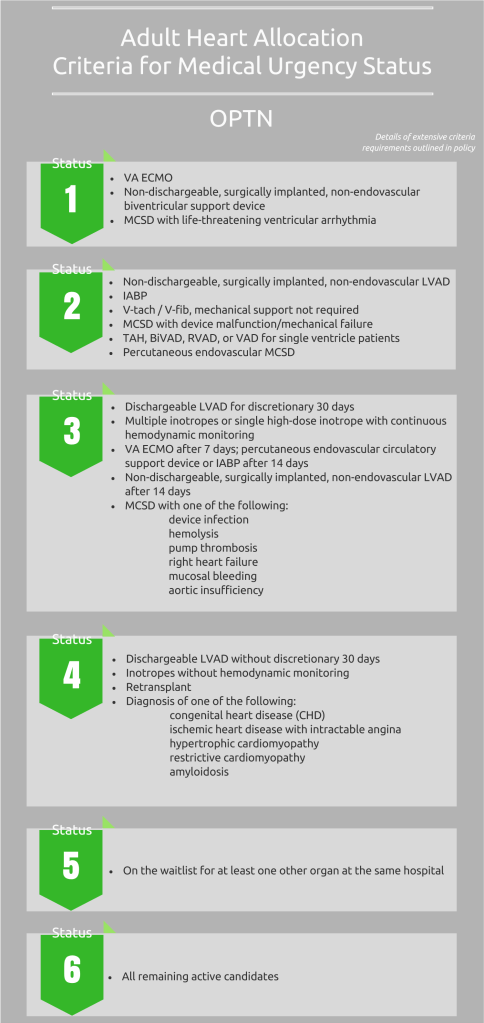
When donor hearts become available, the system offers them first to candidates who are:
- Listed at a transplant hospital close to the donor hospital
- A match with the donor’s blood type
- The most medically urgent
Because hearts can only be preserved for a brief period from donation to transplant, the distance from the donor hospital to the transplant hospital where a patient is listed is a major consideration. The shorter the distance means the shorter the time the organ must be preserved.
Candidates listed at transplant hospitals closer to the donor hospital will get more matching priority than candidates who are in similar medical condition but farther away. When candidates match a nearby donor, the transplant team gets detailed medical information about the organ offer. The team may accept the offer or decline it.
There may be no transplant candidates at hospitals closest to the donor location who are a match for the donor. In those cases, the organ will be offered to patients listed at more distant transplant hospitals. The most medically urgent candidates are considered first, followed by less urgent candidates who are a good match. At any level, if two or more candidates share the same status, then the person who has been waiting the longest gets priority.
LUNG
Every lung transplant candidate receives an individualized lung Composite Allocation Score (CAS). This score determines priority for receiving a lung transplant when donor lung(s) become available.
The lung CAS uses objective medical information about candidate needs and medical condition. The score weighs the varied factors used to make the match. Each factor will get a certain number of potential points, which are then added together to make up a maximum score of 100 points.
The lung CAS uses a framework called continuous distribution. The goals of this framework are to:
- Prioritize sickest candidates first to reduce waitlist deaths
- Improve long term survival after transplant
- Increase transplant opportunities for patients who are medically harder to match
- Increase transplant opportunities for candidates with distinct characteristics like candidates under the age of 18 or prior living donors
- Promote the efficient management of organ placement
A new allocation method was adopted in March of 2023 for lung transplant. This brief video explains the new methodology: Full lung CAS Composition
In the next blog post, we will discuss the allocation process for liver and kidney transplants.
For the record, I want to state that I am not a medical professional. I am a two-time transplant recipient and patient advocate. Please seek advice from your own physician before you make any decisions regarding your healthcare.
I hope that you find this series on transplant medicine to be helpful and informative, and if you have found it to be of value, please share with those you know who may benefit from it. If you want to be sure to receive my blog posts in your inbox, please subscribe. Finally, at the bottom of every page, I have a link to register as an organ donor. You can be a hero to someone in need.
 Dawn Levitt, Author